Request a demo

Norma Capital

SA-CVA or BA-CVA.
Both numbers on your own book, before you choose.

Many banks picked BA-CVA because SA-CVA needs CVA sensitivities to thousands of risk factors across the whole book, and that run never finished. Not because it was the better number: for books that hedge, SA-CVA usually is. Norma computes both on your own book, so you decide on your own numbers.

Approach selection

Which approach is cheaper depends on the book

SA-CVA recognises hedges and is more risk-sensitive, which lowers the charge on hedged, uncollateralised corporate books. It is not always the lower number: EU banks using internal-model exposures inside BA-CVA have reported lower capital under the basic approach, and our own comparisons show the same on collateralised or lightly hedged books. The right approach is a calculation on your own book. The Capital Study returns both numbers with the attribution within days.

Published impact of the new CVA capital framework

+73%
Rise in CVA risk-weighted assets at 18 European banks, Q1 2025 against Q4 2024, after CRR3 went live

The Basel Committee recalibrated the two approaches in July 2020, a 0.65 scalar on BA-CVA and a multiplier of 1.0 on SA-CVA, so that the simpler approach is not systematically cheaper. Which one is lower for a given book is a property of the book. The Capital Study measures it.

Regulatory calendar

Timeline

1 Jan 2025

EU, CRR3

Live. Exemptions retained for non-financial counterparties below the clearing threshold, sovereigns and pension funds; the hypothetical charge on exempt trades is now reported.

2026

Decisions

Approach, vendor and supervisory approval work for the UK all happen this year.

1 Jan 2027

UK, Basel 3.1

SA-CVA or BA-CVA, with a simplified fallback only for small derivative books. Exemptions end for new trades with sovereigns and corporates; legacy trades optionally exempt to 2030.

2028+

US

March 2026 re-proposal, no compliance date yet. SA-CCR inside BA-CVA is expected to make SA-CVA the efficient choice.

The Capital Study: both approaches on your book within days

Send a trade file for an agreed scope of the book, netting and CSA terms and a market-data snapshot as of one date. Within days you have SA-CVA and BA-CVA capital on the agreed scope of your book side by side, hedge benefit, netting-set and counterparty attribution, and the uncovered tail shown explicitly with its charge under each approach.

Results come as a written report for your capital committee and as a working session on your numbers, so your team can drill down to the positions behind them.

What you send

  • Trades: FpML, CSV templates or your trade-system export
  • Netting sets and CSA terms
  • CDS spreads, proxy mapping, existing CVA hedges, counterparty sector and rating
  • Curves, vol surfaces and cubes, FX, as of date
  • Current CVA RWA for reconciliation
Request the Capital Study

Sensitivities by risk factor

The inputs to the capital number

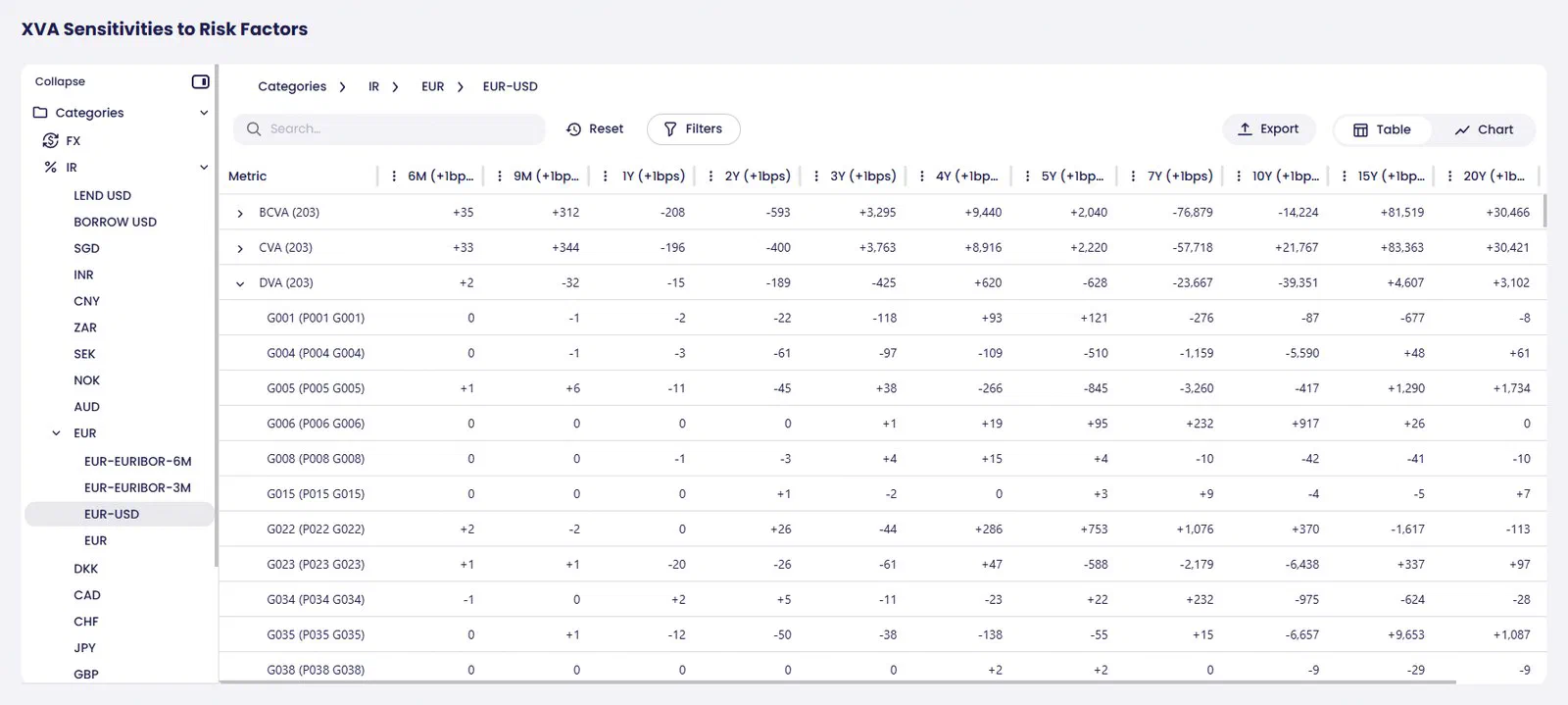
Sensitivities by risk class, FX, rates and credit, for CVA, DVA and BCVA across the book, and for the regulatory CVA that SA-CVA aggregates, open to inspection line by line.

  • Delta and vega by risk class
  • CVA and eligible hedges
  • Exportable for the regulatory return
The Capital Study
XVA sensitivities grouped by FX, interest rate and credit risk factors, with drill-down to individual curves and netting sets, as a table or a chart

Down to the currency and the index

The same sensitivities per netting set, per currency and per index, so a capital number can be traced to the positions that drive it.

  • Per netting set, per currency
  • Per curve and index
  • Table or chart
Request a demo
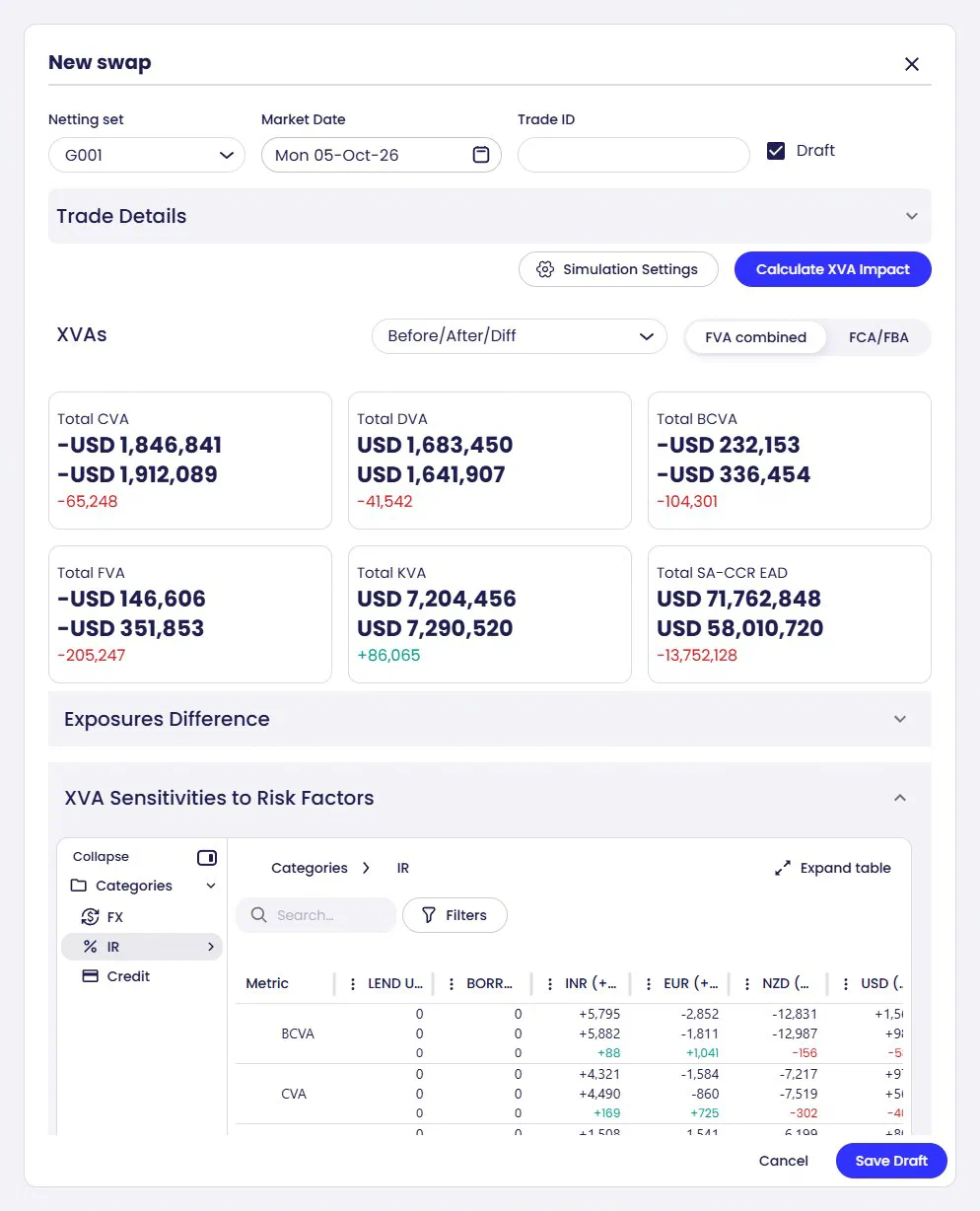
How the new trade changes the XVA sensitivities to each risk factor, shown below the XVA impact totals

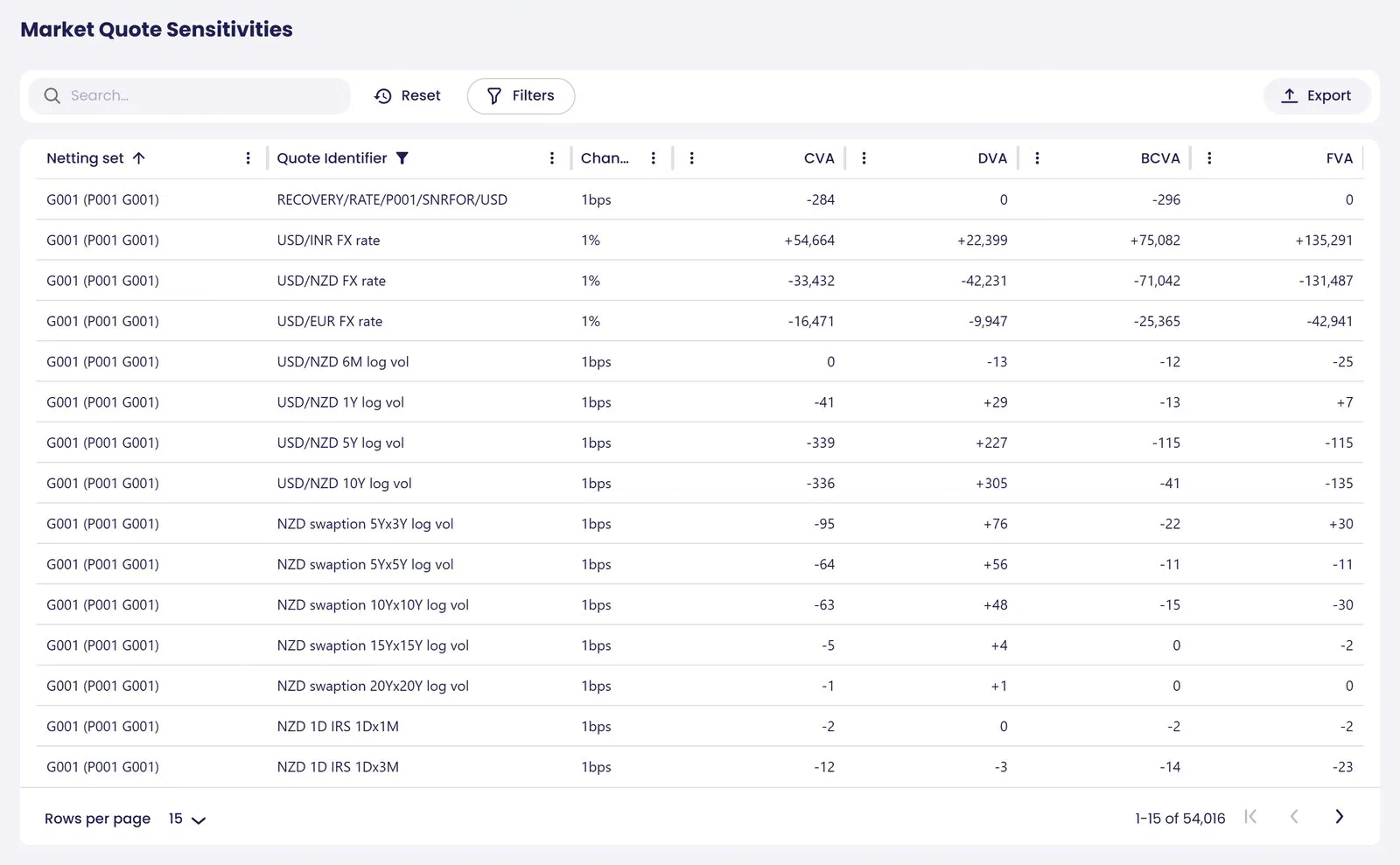
And to every market quote

Sensitivities to each FX rate, swaption volatility and swap rate the book is marked on, per netting set, tens of thousands of rows on a million-trade book.

  • FX rates, vols, swap rates
  • Per netting set
  • Filter, search, export
Benchmarks
Sensitivity of each XVA to individual market quotes per netting set, with search, filters and export

Coverage

Vanilla and exotic derivatives across all asset classes, plus custom scripted payoffs. Any currency. CVA, DVA, BCVA, FVA with FCA and FBA, MVA, ColVA, KVA; initial margin under ISDA SIMM; expected exposure, ENE and PFE profiles, with and without initial margin. SA-CVA and BA-CVA capital with hedge recognition. SA-CCR exposure and capital, with collateral and initial margin recognised. Netting sets and CSA terms of all common types, variation and initial margin.

SA-CVA and BA-CVA on your own book, side by side, within days.

Request a demo

Questions

Is SA-CVA or BA-CVA the lower capital charge?

It depends on the book. SA-CVA recognises hedges and is more risk-sensitive, so on hedged, uncollateralised corporate books it is usually lower. On collateralised or lightly hedged books BA-CVA can be lower. The Capital Study computes both on an agreed scope of your own book, side by side, within days.

What does the Capital Study need from us?

A trade file for the agreed scope (FpML, CSV templates or your trade-system export), netting sets and CSA terms, CDS spreads with proxy mapping and existing CVA hedges, your curves, vol surfaces and FX as of one date, and your current CVA RWA for reconciliation.

When do the new CVA rules apply?

In the EU, CRR3 has applied since 1 January 2025. In the UK, Basel 3.1 applies from 1 January 2027, with SA-CVA or BA-CVA; a simplified fallback exists only for small derivative books. In the US the March 2026 re-proposal has no compliance date yet.

Can SA-CVA sensitivities be run often enough?

Yes. Norma computes the full set of CVA sensitivities to every supervisory risk factor on a million-trade book in under a minute, so SA-CVA can run intraday rather than monthly.

Get in touch

Request a demo on your own trades, or just talk to us.